

Skip to content
FREE shipping on orders over $200 🇺🇸 + 🇯🇵
INTERVIEW

Looking Closely with Jun Oson

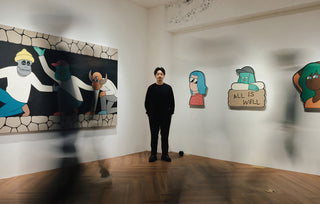
Jun Oson is an artist based in Kamakura whose work balances humor, surrealism, and a quiet sensitivity to everyday life. His characters—instantly recognizable by their distinctive peanut-shaped faces—move through worlds where humans, animals, robots, and monsters coexist without hierarchy or explanation.

Drawing from manga, Western pop art, and the distortions that develop between cultures, Oson’s work captures moments that feel both familiar and slightly offbeat. A figure pauses, waits, or simply exists within a scene that hints at a larger story just out of view.

In this conversation, we speak with Oson about the evolution of his visual language, the role of observation in his practice, and how small, often intangible experiences shape the emotional undercurrent of his work.

For readers encountering your work for the first time, could you briefly introduce yourself and your practice?

My name is Jun Oson. I’m an artist and illustrator. About ten years ago, I moved from Tokyo to Kamakura.

As an artist, I express myself through painting, and I’ve exhibited not only in Japan but also across Asia, Europe, and the United States. On the commercial side, I work mainly in advertising, and also create goods and animation.

I love both sides of my practice equally, and approach them without really drawing a line between them.

Your characters are immediately recognizable, particularly their distinctive peanut-shaped faces. How did this visual language first begin to emerge?
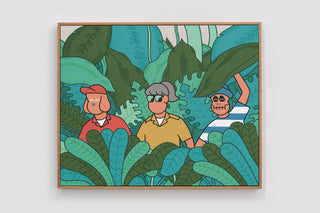
About twenty years ago, I was working as a graphic designer in a regional city. The studio I was at wasn’t doing what I’d call particularly interesting work, and I started thinking, “I want to do something more fun—something where I can express myself.”

That’s when the idea of becoming an illustrator came to me, since drawing had always been something I was good at. At the time, I thought, “If I’m going to be an illustrator, I need a distinctive style.” I was really into the British artist James Jarvis then, so I started referencing his characteristically potato-like outlines.

For some reason, I became convinced that the head shape needed to be distinctive, so I explored a few variations before landing on the form I use now.

The figures in your work often feel familiar yet difficult to place culturally or geographically. Is that ambiguity intentional?

In my twenties, I don’t think I was that consciously aware of it, but looking back now, I probably was.

Growing up in Japan in the ’80s and ’90s, there was a strong sense of admiration for America and Europe. I was raised with this feeling that “Japan is kind of lame, and the US and Europe are cool.” But at the end of the day, I’m Japanese. Even if you try to bring in Western culture as-is, it inevitably gets filtered into something more “Japanese” along the way.

Back then, I used to look at that and think it felt a bit awkward or uncool. But now I see that those distortions—those subtle shifts born from that admiration—really stayed with me. I’ve come to feel that those kinds of distortions are actually what make things interesting, and I still try to bring that essence into my work today.

Your paintings frequently place humans alongside monsters, robots, or animals. What interests you about bringing these different beings together in the same scenes?

I think this part of my work is influenced by Japanese manga. Especially Akira Toriyama’s Dr. Slump (Arale-chan). Star Wars is another reference.

In those worlds, all kinds of beings—people, creatures, robots—just live side by side without much explanation. For me, it’s pretty simple: isn’t it more fun when there’s a mix of different kinds of characters?

Many of your works depict moments that feel quiet or slightly surreal—people sitting, waiting, or sharing space. What draws you to these kinds of everyday situations?

This might also come from manga. Since manga is built through a sequence of panels, when you pull out a single frame on its own, it can become a really strange, almost uncanny scene.

For example, imagine a single panel of Goku from *Dragon Ball* looking surprised. When you isolate just that moment, it takes on this very peculiar atmosphere.

In that sense, maybe there’s also some influence from Roy Lichtenstein. But I’ve always been drawn to taking a single frame out of a larger story.

Observation seems central to your work. Do ideas often begin with things you notice in daily life?
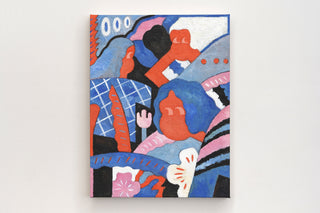
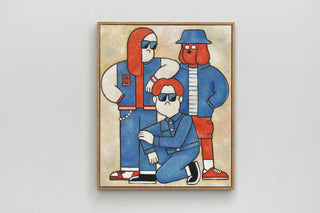
Observation probably does play a big role in how I make my work. I try to experience as many different things as I can. That said, those experiences don’t often translate directly into a piece. It’s more like the feelings I take away from them end up shaping the work.

I was raised with this feeling that “Japan is kind of lame, and the US and Europe are cool.” But at the end of the day, I’m Japanese. Even if you try to bring in Western culture as-is, it inevitably gets filtered into something more “Japanese” along the way.

You’ve spoken about enjoying hiking and spending time outdoors. When did walking or being in nature become part of your life?

It’s actually pretty recent that spending time in nature became part of my life. I can point to it clearly—it was when I turned 30.

My wife and I started hiking because we wanted to find something we could enjoy together long-term. Before that, I’d been invited to go hiking a few times, but I always turned it down, thinking, “Why would I go through the trouble of climbing a mountain?”

We started with smaller mountains, and before I knew it, I’d really fallen for the feeling of being out in nature, mountains included.

Does being in nature influence your creative process or the way you think about your work?
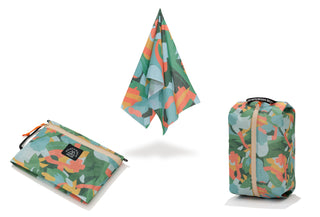
I think it does have an influence, but not in a direct way. Unless it’s for outdoor-related work, I don’t often depict natural landscapes in my paintings. If anything, nature serves more as a way for me to reset my mind.

Your work draws from both Japanese visual culture and Western influences. What artists, images, or media have shaped your visual imagination over time?

For me, Western culture has always been something I admire, but the foundation of my work comes more from Japanese artists who have taken that influence and reinterpreted it in their own way. Artists like Yutanpo Shirane and Kei Wakano come to mind.

In that sense, Japanese magazines like relax, Studio Voice, and +81 had a big impact on me, since they presented these distinctly Japanese interpretations of Western culture.

I also really love Japanese films from the ’80s and ’90s that have a slightly stylish, refined atmosphere.

What does a typical day in the studio look like for you? What are you currently curious about or exploring in your work?
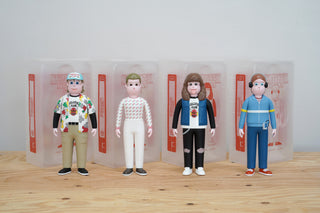
Since my child is still young, I need to be home by the evening, so I’m basically working most of the time. Sometimes I finish client work on a pen tablet, and other times I’m painting on canvas. That said, I always make time for a nap. I make sure to have that time, no matter what.

I also watch interviews on YouTube with people visiting Japan from abroad. Most of them are praising Japan, which always puts me in a good mood. And I like mystery novels, so I’ll read a few pages here and there when I have time.

Lately, what I’m interested in exploring in my work is how to bring together my usual pop style with oil painting, which I only started working with in the past few years. Earlier you mentioned that my work draws from both Japanese visual culture and Western influences, and I think this is part of that as well.

In Oson’s world, little is overly explained. His work resists clear categorization and instead invites a slower kind of looking.

Shaped by observation and everyday experiences, his paintings create space for ambiguity and quiet reflection. In these moments, we’re reminded that the ordinary often deserves more of our time and appreciation.

See more of Jun Oson's work and follow him on Instagram: @junoson

Published

Interview

Jonathan Rahmani

Images

Jun Oson
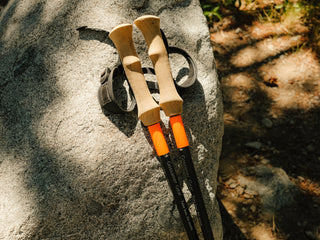
SANPO SHOP

Products with purpose

Shop items we use from brands we love, along with a few creations of our own. Quantities are limited.